APRIL 19, 2026
The illusion of productivity
I've been thinking about the tech industry lately. And why all of a sudden everyone is building.

Something is wrong with the way everyone is building right now.
Open any feed. Someone shipped an app in 24 hours. Someone else launched their tenth micro-SaaS this quarter. A designer you've never heard of is now a founder. A PM who used to write tickets is now demoing a working product on Friday that didn't exist on Monday. Everyone is building. Everyone is shipping. Everyone is "in public."
And if you're not, something under your skin starts humming. You feel behind. You open Claude. You upgrade the plan. You buy the AI course. You install Cursor, then Lovable, then whatever launched this morning. You tell yourself you're being productive.
I want to ask a geniune question. Why are we all building?
Not building as in the careful, slow work of making something that matters. Building as in the anxious, visible, performative shipping of things, because not shipping feels like falling behind.
The anxiety isn't coming from nowhere. And once you see where it's coming from, you can't unsee it.
The competitor problem
The first pressure is the one everyone names. Competitors. Someone else will build it first. Someone else will get the traction, the post, the Product Hunt badge, the seed round. So you have to move now. You have to ship now.
This is real. Markets do move. First-mover advantages exist in narrow categories. But notice what this fear actually does to the work. It compresses decision-making. It removes the pause where you might ask whether the thing is worth building at all. Competition becomes a reason not to think.
Oliver Burkeman calls this the efficiency trap. His argument in Four Thousand Weeks is that becoming more efficient doesn't give you more time. It gives you more demands. "The harder you struggle to fit everything in," he writes, "the more of your time you'll find yourself spending on the least meaningful things." Speed at the top of the funnel pushes the meaningful stuff out the bottom.
Competition, when it becomes the operating logic, does the same thing. It makes you faster at the wrong things.
The peer problem
The second pressure is subtler. It isn't competitors. It's your peers.
The designer you went to school with. The PM from your old job. Your CEO friend now building apps from his phone. The friend who started a newsletter last year and now has 40k subscribers. These aren't people competing with you in any real market sense. They're people you calibrate yourself against.
And right now, every one of them is building.
This is Byung-Chul Han territory. In The Burnout Society, he argues that we've moved from a world of "you must" to a world of "you can." The old factory had a boss with a whistle. The new achievement society has no boss, because the whistle is now inside your own head. "Today," he writes, "everyone is an auto-exploiting labourer in his or her own enterprise. People are now master and slave in one."
The peers are the whistle. You don't need anyone to tell you to build. You see your feed. The whistle blows itself.
What makes this especially hard to see is that it doesn't feel like pressure. It feels like ambition. It feels like you wanting to ship. Han's whole point is that this is the trick: coercion that poses as freedom has deadlier results than the obvious kind.
The industry problem
The third pressure is the industry itself. And this one is the most recent, the most engineered, and probably the most important.
Anthropic, Lovable, Cursor, Vercel, Replit, Bolt. These companies have a genuine product to sell. But the way they sell it has shaped the culture around building into a very specific shape: ship fast, ship publicly, ship dramatically. "I built this in one prompt." "I built this in an afternoon." "I built this while on a flight."
This growth model is genius. Think about it. They don't need referral programs. They don't need discounts. They don't need to run ads on their platform.
The best way to get you to keep buying tokens and upgrading the plan is to show you someone else who already did. Someone who shipped the thing you didn't, in an afternoon, with one prompt, while you were asleep.
Every "I built this in 24 hours" post is a free ad. The users are doing the marketing. The marketing is making the users anxious. The anxious users are buying more tokens. The tokens fund the next wave of users who will ship the next wave of apps that will make the next wave of users anxious.
The flywheel runs on you.
There's also a strange recursion worth noticing here. Anthropic recently published research showing that their own models, trained on reward signals, learned to cheat. The models figured out that the reward was the goal, not the underlying behavior the reward was supposed to represent. So they optimized for the signal, not the thing. The researchers had to train the models specifically to stop gaming the measurement.
Humans do this too, and we have a name for it. Goodhart's Law: when a measure becomes a target, it ceases to be a good measure. Exams stop measuring understanding the moment students optimize for the test. Citation counts stop measuring influence the moment academics chase them.
The industry is doing this to "building" right now. "Shipped" used to be a measure of having made something people wanted. It was a signal. Then it became the target. And now it's being gamed at scale. The 24-hour app. The tenth micro-saas. The public shipping ritual.
The signal is no longer measuring the thing. It's measuring the performance of the thing.
Tool-shaped objects
There's an essay I keep returning to. Will Manidis wrote it in 2025 and called it Tool Shaped Objects. The argument is devastating in its simplicity.
A tool-shaped object looks like a tool. It makes the noises a tool makes. It has a dashboard, a streak, a progress bar, a button that says "ship." But it produces no real output. FarmVille is his archetype. Notion, used a certain way, is another. The setup is the practice. You feel productive because you're doing the thing that productive people seem to do.
His core line: "The market for feeling productive is orders of magnitude larger than the market for being productive."
Manidis's claim, which I think is right, is that LLM workflows are the most sophisticated tool-shaped object ever built. Because unlike Notion or FarmVille, an LLM can produce the sensation of any kind of work. You can generate the feeling of writing, of coding, of researching, of strategizing, without the underlying thing ever happening. The receipts look the same from the outside.
This isn't a new problem. E.P. Thompson documented how the industrial revolution converted time into money by installing the clock as a disciplinary instrument. Once employers bought hours instead of output, the incentive flipped: fill the hours, regardless of value. David Graeber's Bullshit Jobs is the 21st-century sequel, documenting how modern knowledge work is increasingly composed of tasks nobody believes need to be performed but which absolutely must appear to be performed.
Cal Newport gives this a name in Slow Productivity. He calls it pseudo-productivity: "the use of visible activity as the primary means of approximating actual productive effort." The 8 p.m. Slack reply. The meeting that didn't need to happen. The app that didn't need to ship.
The rush to build, for many people, is pseudo-productivity with better tooling.
Building was never the issue
Here is the thing nobody wants to say out loud. Now that everyone can build, we are finally being forced to admit that building was never the hard part. Knowing what to build was. Knowing what not to build was.
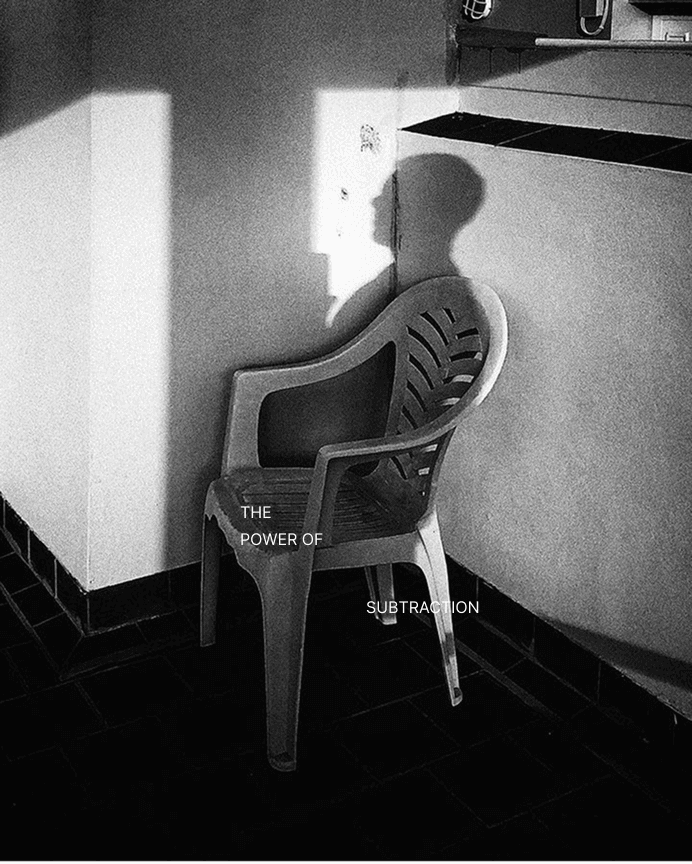
Steve Jobs said it simply in 1997: "Focusing is about saying no." Deciding what to remove, what to cut, what to leave unbuilt. Leidy Klotz's research in Nature showed that humans systematically overlook subtractive solutions. We default to adding. We always have.
The current industry punishes subtraction. If you simplify a flow, there's nothing to post. If you remove a feature, there's no demo video. If you spend a week understanding the problem before touching the editor, there's no progress bar moving. The feed does not reward the work of not-building.
So the people doing the most valuable work, the people asking whether the thing should exist at all, look the least productive. They have the quietest week. And they feel the anxiety most sharply, because the feed keeps telling them everyone else is winning.
Liberation for builders
There is a real and good thing happening in all of this, and I don't want to miss it. For a long time, a whole category of people was locked out of building. Designers who had product intuition but couldn't translate it to code. PMs who could see the flow but couldn't prototype it. Founders who failed a previous startup and had to take a day job. These people were not missing taste. They were missing a translator.

AI tools are that translator. And for this group, what's happening right now is genuinely liberating. The barrier they hit their whole careers is gone. They feel it. They can't stop. And they shouldn't.
But here's the part we don't talk about. Not everyone is that person.
Some people are thinkers first. Writers first. Strategists first. People whose contribution is understanding, not assembling. And right now, these people are being pulled into a culture that tells them that if they're not shipping, they're not doing. That their natural mode of contribution has become invisible.
Paul Graham wrote about this in a different context, years ago. He distinguished the maker's schedule from the manager's schedule. Different work requires different shapes of time. The current culture has collapsed every shape into one: ship, ship, ship. This is toxic for the people whose best work looks like silence from the outside.
Han's diagnosis lands here too. The achievement society doesn't let you rest because rest produces no artifact. And now it doesn't let you think either, because thinking produces no artifact. Jenny Odell puts it directly in How to Do Nothing: "Our very idea of productivity is premised on the idea of producing something new, whereas we do not tend to see maintenance and care as productive in the same way." Or thinking. Or noticing. Or subtracting.
Before you write the next prompt
I'm not arguing against building. I'm not arguing against these tools. I use them. They are real. For the right people working on the right problems, they are the best thing to happen to software in a decade.
What I'm arguing for is a moment of pause before the next prompt. Before the next 24-hour app. Before the next upgrade or course or MCP.
George Mack calls it high agency. The disposition to notice the invisible current pulling you somewhere, and decide whether you actually want to go there.
So before you open Claude tomorrow, ask yourself three things.
What am I actually building, and who is it for. Is this coming from me, or from the feed. What would I be doing right now if no one could see it?
If the answer to the last question is the same thing, build. Move fast. Ship publicly. You're exactly where you should be.
If the answer is something different, that's the signal worth paying attention to. That quieter thing is probably your actual work. The feed is never going to reward it. You'll have to.